
The choice depends on whether the part needs moderate strength in the supplied condition or a deliberately carburised surface with a tougher core. By comparing chemistry, delivery-condition properties, heat treatment, machining, wear and load requirements, you can decide when EN 3B is the lower-risk grade and when EN 32B earns its extra processing.
Key takeaways
- Choose EN 3B for moderate loads, easy machining and a tough low-carbon core.
- Choose EN 32B when case hardening needs a harder wear-resistant surface.
- Compare chemistry, delivery condition and mechanical properties before ordering.
- Specify the finished part, heat treatment, dimensions and inspection documents.
The grades solve different engineering problems
EN 3B and EN 32B solve different engineering problems. EN 3B is the legacy BS 970 070M20 designation for a general-purpose low-carbon steel; it is not normally a high-alloy steel or a tool steel. EN 32B is the legacy 080M15 or C15-type case-hardening grade, subject to confirmation against the material specification you select.
The practical choice is simple: EN 3B suits supplied-condition machining, moderate strength and easier welding, while EN 32B earns its place when carburising is part of the component design. Carburising creates a hard, wear-resistant surface while the low-carbon core remains tougher; EN 32B is not automatically hard through its full section.
For an EN 3B or EN 32B round bar purchase, use this decision sequence:
1. Choose EN 3B for parts that will be turned, drilled, sawn or threaded in the supplied condition and do not need a designed carburised case.
2. Choose EN 32B when the finished part requires a specified carburised surface, controlled quenching and tempering, and a defined hardness profile.
3. Confirm the current grade designation, governing standard, delivery condition and test requirements before ordering. Historical names alone do not define chemistry, mechanical properties or heat-treatment performance. A drawing or purchase order that says only “EN 3B” or “EN 32B” leaves important acceptance criteria unresolved.
Compare chemistry and supplied-condition properties before choosing
Use legacy BS 970 Part 1:1983 data only as a comparison guide; confirm the current specification before design. The EN 3B versus EN 32B choice does not create stainless performance: both are low-alloy steels, with no intentional nickel, chromium or molybdenum additions.
| Grade | Carbon | Nickel / chromium / molybdenum | Supplied-condition properties |
|---|---|---|---|
| EN 3B (070M20) | 0.15–0.25% | No intentional alloy additions; residual limits depend on the standard | Hot-rolled or normalized: yield about 250 MPa, tensile 400–550 MPa, elongation about 25%, hardness about 120–170 HB |
| EN 32B (080M15) | 0.12–0.18% | No intentional alloy additions; residual limits depend on the standard | Hot-rolled or normalized: yield about 280 MPa, tensile 430–580 MPa, elongation about 22%, hardness about 130–180 HB |
These figures are representative legacy BS 970 values, not design allowables. Bar diameter, actual heat chemistry, rolling or normalizing condition, sampling direction and test standard can change the result; an annealed bar will not match a normalized bar.
Charpy impact is not universally specified for these legacy grades. Do not assign a test temperature, specimen direction or minimum absorbed energy unless the selected material specification states them; put the required Charpy temperature, direction and minimum value in the project specification.
Neither grade resists corrosion like stainless steel. Exposed parts need a defined system such as plating, oiling, painting or sealing, and catalogue ranges must not replace certified test results or design verification.
Heat treatment decides whether EN 32B earns its place
Machine EN 3B in its low-carbon supplied condition, then add surface hardness only when wear requires it. The treatment sequence is approximate, because the processor must approve temperatures, times and quenching media for the section size.
- Turn, drill, saw or thread the bar before treatment.
- Carburise or carbonitride the finished surface.
- Quench under the approved case-hardening procedure.
- Temper, or complete another approved case-hardening cycle, to balance hardness, toughness and distortion.
The intended result is a hard, wear-resistant case over a softer, tougher core. The process does not guarantee one case depth; carbon potential, furnace time, temperature, section size and measurement method control the result.
EN 32B follows the same design logic but is selected specifically for carburising: carburise at the specified temperature for the specified time, quench under controlled conditions, then temper to the required surface hardness and distortion limit. Its useful hardness is concentrated in the carburised layer, not automatically through the full bar.
That distinction matters in en 32b round bar applications such as gears, pinions, bushes, cams, rollers and sprockets. Neither grade name guarantees finished hardness, effective case depth or impact resistance. Confirm the carbon potential, furnace time, section size, quench practice and specified hardness or case-depth measurement convention before approval.
A material certificate identifies the steel; it does not certify the final heat-treated component.
Choose EN 3B when the part needs a tough core, easy machining or moderate loads
Choose EN 3B when surface wear is modest and the part will be turned, drilled, sawn or threaded in the supplied condition. Its low-carbon structure supports easier machining, simpler welding and lower processing risk than a component designed around a hardened case.
Typical EN 3B round bar uses include bushes, pins, lightly loaded gears, shafts, cams, studs, axles, spacers, brackets and general machine parts. These examples do not guarantee suitability: check load, fatigue, temperature, speed and safety requirements before approving the design.
| EN 3B | Choose it for moderate loads, supplied-condition machining, easier welding and a tough, workable core |
|---|---|
| EN 32B | Choose it for a specified carburised case on a tougher core, with controlled hardening and distortion |
The decision rule is direct: choose EN 3B instead of EN 32B when case-hardened surface wear resistance is not the priority and the component carries moderate loads.
EN 32B round bar applications include gears, pinions, rollers, sprockets, cams and bushes where the carburised surface is part of the design, not an automatic result of buying the bar.
Do not choose either grade for high through-strength, uniform hardenability or severe impact loading throughout the section. In those conditions, a suitable quenched-and-tempered alloy steel or impact-rated specification deserves consideration.
Write the purchase specification around the finished part
Turn an en 3b or en 32b round bar decision into a finished-part specification, not a catalogue-name request. Put these details on the purchase order:
1. State the current material designation and governing standard, then add “EN 3B alloy steel bar” only as a historical identifier. Specify diameter, length, dimensional tolerance, supply condition—hot-rolled, normalized, annealed or forged—and straightness and surface requirements.
2. Require the supplied heat number, ladle chemical analysis and mechanical tests. Name the tensile, yield, elongation and hardness requirements, test direction and standard, then demand a certificate traceable from the bar to that heat.
3. For EN 32B, define the carburising method, carbon-potential control, target effective case depth, surface hardness and core hardness. State quench and temper temperatures, cooling medium, distortion limit and the hardness convention, such as ISO 18203 with its effective-depth criterion or ISO 6507/6508 for hardness measurement.
4. For welded parts, require a qualified welding procedure, preheating where the procedure demands it, low-hydrogen consumable storage and hydrogen control. Specify post-weld stress relief or other treatment; reassess the procedure after case hardening because a hardened case can crack or lose its specified profile.
5. Do not treat EN 32B as stainless steel. Specify plating, oiling, painting or sealing when corrosion exposure requires it.
Steel Mart’s forged and machined stock service can help align grade, condition, dimensions and inspection documents, but the designer must verify final performance against the selected standard and heat-treatment procedure.
Related product
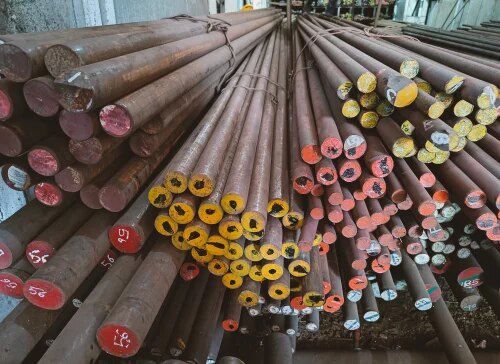 | Alloy Steels Products Other Details: Steel Mart is an Iso 9001:2008 Company and Was Established in the Year 1986Steel Mart is in a Position to Cater to Your... View product → |
Frequently asked questions
What is the main difference between EN 3B and EN 32B round bar?
EN 3B is a general-purpose low-carbon steel for moderate loads and easy machining. EN 32B is a case-hardening grade selected when a hard wear-resistant surface and tougher core are required.
When should you choose EN 3B round bar?
Choose EN 3B for parts that need a tough core, straightforward machining and moderate strength without a case-hardening process.
Why does heat treatment matter when choosing EN 32B?
EN 32B earns its place when carburising or another case-hardening process can create the required surface hardness while retaining core toughness.
What should you include in an EN 3B or EN 32B round bar purchase specification?
State the grade designation, diameter and tolerance, supplied condition, heat-treatment requirement, mechanical properties, inspection standard, test certificate and traceability details.