
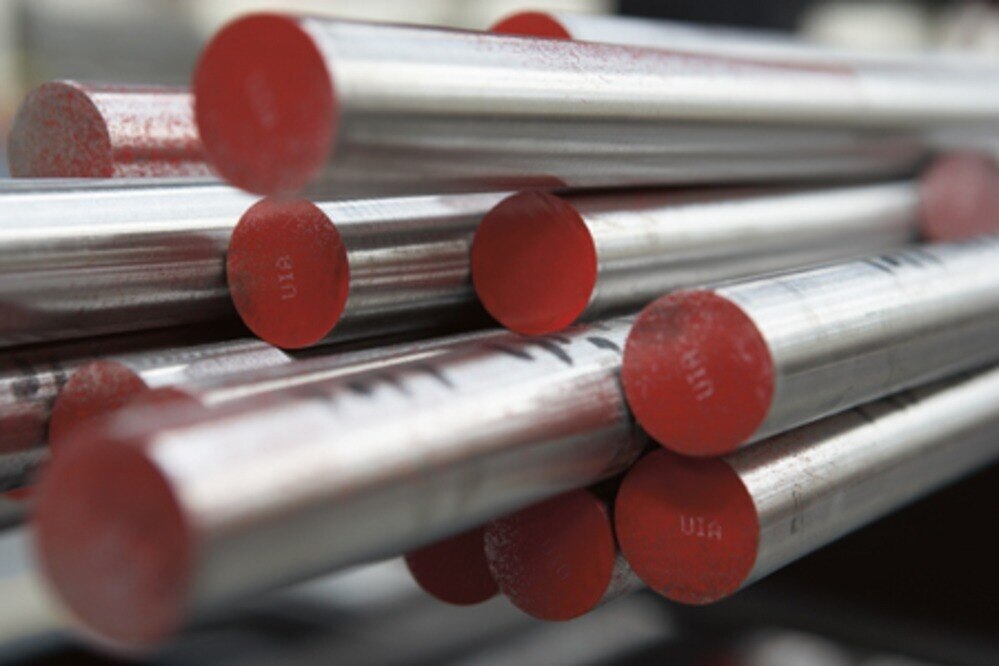
A plate marked only “S355” does not tell you whether it is suitable for a pipe rack, a tank attachment or a pressure boundary. You need to identify the EN 10025-2 subgrade, thickness, impact requirement, design code and traceable test documentation before approving it for petrochemical fabrication in Bengaluru.
Key takeaways
- Do not use 355 MPa for every S355 thickness calculation.
- Confirm whether the component carries pressure before selecting S355.
- Match the purchase order, mill certificate and welding procedure.
- Choose corrosion-resistant or wear-resistant plate when service conditions demand it.
What S355 means—and how it compares with Indian and pressure-vessel grades
S355 is primarily an EN 10025-2 non-alloy structural steel designation, not a universal petrochemical pressure-vessel grade. Its minimum yield strength is 355 MPa up to 16 mm thickness, then decreases by thickness range to approximately 265 MPa above 250 mm and up to 400 mm. Using 355 MPa for every plate calculation is incorrect.
S355JR, S355J0 and S355J2 identify nominal Charpy impact-test temperatures of +20 °C, 0 °C and −20 °C respectively. Select the subgrade from the minimum design metal temperature and fabrication conditions, not stock availability.
| Grade | Primary role | What must not be assumed |
|---|---|---|
| S355 | EN 10025-2 structural plate | It is not automatically pressure-vessel approved |
| IS 2062 E350 | Indian structural steel | Similar yield strength does not prove identical chemistry, toughness or weldability |
| SA 516 Grade 60 or 70 | Pressure-vessel plate | Code acceptance, inspection and heat treatment follow a different route |
| IS 2002 grades | Indian boiler and pressure-vessel steels | The specified grade and governing code remain decisive |
| SAILMA 350 | Indian high-strength structural steel | A similar nominal strength does not establish equivalence |
Therefore, a purchase description for s 355 carbon steel plate for applications in Bengaluru must state the subgrade, thickness, dimensions, delivery condition and EN 10025-2 product standard. Add the heat number, test results and EN 10204 Type 3.1 certificate. “S355” alone is incomplete.
For s 355 plate for petrochemical equipment, verify chemistry, toughness, weldability, inspection requirements and code acceptance against the project specification before substituting it for an Indian or pressure-vessel grade.
Where S355 works in a Bengaluru petrochemical plant—and where design conditions change the answer
Pipe racks, access and maintenance platforms, stairs, ladders, structural skids, equipment supports, base plates, brackets and non-pressure-retaining frames are defensible carbon steel plate applications in Bengaluru petrochemical plants. These components carry loads without containing process fluid.
An S355 structural plate is not automatically suitable for a vessel shell, boiler, heat exchanger, process pipe or any other pressure-retaining component. S355 plate for petrochemical equipment needs a separate code and material-acceptance decision.
1. Map the component. Use S355 only where the project material requisition and structural design permit EN 10025-2 or IS 2062 material. Confirm the thickness-specific strength, subgrade and toughness before fabrication.
2. Test the design conditions. Check design pressure, design temperature, minimum design metal temperature, cyclic loading, hydrogen exposure, sour service, chloride exposure, fire-case loading and corrosion allowance. Ordinary S355 does not establish suitability for these duties.
3. Verify the governing document. For pressure equipment, check ASME Section VIII and the project requisition. For applicable storage tanks, check API 650; for applicable low-pressure tanks, check API 620. Do not substitute S355 because its nominal yield strength appears similar to another grade.
S355 can serve an atmospheric tank or secondary steelwork only after the separate tank, containment, structural and corrosion requirements are satisfied. Bengaluru’s rain, humidity, condensation and process contaminants still demand a defined coating and inspection system.
This boundary prevents a common error: treating a structural designation as proof of containment performance.
What the purchase order, certificate and welding plan must prove
Specify s 355 plate for petrochemical equipment by evidence, not by name alone. Your purchase order must state dimensions, thickness, EN 10025-2 grade and subgrade, delivery condition, inspection level, and EN 10204 Type 3.1 certificate.
1. Require the certificate to identify the heat number and report chemical analysis, tensile strength, yield result, elongation, Charpy impact-test temperature and result, and heat-treatment status. Match its certified thickness range to the design calculation: minimum yield strength and impact requirements change with plate thickness. Add EN 10029 dimensional and flatness tolerances.
2. Order EN 10160 ultrasonic testing when lamellar tearing or internal discontinuities matter. Name the testing class and acceptance level; EN 10025-2 alone does not provide that examination. Reject a generic “S355” certificate that cannot preserve mill traceability.
3. Approve welding only against a qualified WPS and PQR and suitably qualified welders. Review carbon equivalent, joint restraint, thickness and heat input before setting preheat and interpass temperature.
Specify classified low-hydrogen consumables, sealed storage and hydrogen control, PWHT where the design or procedure requires it, and radiography, ultrasonics or magnetic-particle testing as defined by the inspection plan.
Before fabrication, verify flame-cutting allowance, edge condition, lifting points, plate distortion and marking. Confirm that blasting removes damaged scale without erasing identification, and that the selected primer is compatible with the specified coating system. Record heat identity on every cut piece.
How Bengaluru procurement and site conditions affect the plate decision
Do not approve an S355 carbon steel plate supplier in Bengaluru from a catalogue grade alone. Use the evidence below to test what will arrive, how it will be identified and whether the schedule fits your fabrication plan for carbon steel plate applications in Bengaluru.
1. Ask for available stock thicknesses, cut-to-size capability, minimum order quantity and delivery lead time. Confirm whether long or heavy plates need special vehicles, lifting equipment or route planning.
2. Require original mill traceability, continuous heat-number identity after cutting, an authentic EN 10204 Type 3.1 certificate and third-party inspection options. Ask how remnants are marked, recorded and segregated.
3. Inspect storage and processing controls. Mixed heats can invalidate assumed chemistry and toughness; generic certificates cannot prove the supplied plate; damaged mill scale hides corrosion or handling damage; unmarked cut pieces lose identity in safety-critical fabrication.
Bengaluru’s inland location does not prevent corrosion. Monsoon rain, humidity, condensation, process emissions and industrial contaminants require covered storage, raised dunnage, drainage, edge protection and a defined coating system.
Confirm local fabrication capacity for cutting, drilling, blasting and primer application, then allow time to review certificates, heat records, inspection reports and coating compatibility before dispatch. Steel Mart may be evaluated against these same records and capabilities, but its name does not replace verification of the offered plate, documents or delivery.
Related product
 | Alloy Steels Products We supply an outstanding assortment of Carbon Steels Plates, which are crafted using finest quality raw material at our vendor's end. View product → |
A decision checklist: when to choose S355, pressure-vessel plate or corrosion and wear-resistant material
Choose S355 for secondary steelwork, not because it is a universal petrochemical plate. It fits s 355 carbon steel plate for applications in bengaluru when EN 10025-2 is accepted, the thickness-specific yield value passes the calculation, JR, J0 or J2 toughness is documented, and welding and corrosion controls are defined.
| Option | Use | Decision trigger |
|---|---|---|
| S355 | Structural or secondary steelwork | Code accepts EN 10025-2 |
| SA 516 Grade 60/70 or IS 2002 | Pressure-retaining equipment | Code or requisition requires pressure-vessel plate |
| Stainless steel, coating, lining or allowance system | Corrosive service | Chlorides, wet service, caustic, sour service, CUI or atmosphere controls selection |
| Wear-resistant plate | Abrasive contact | Wear, not yield strength, governs |
Do not substitute S355 for a pressure vessel, boiler, heat exchanger shell or process pipe. Choose SA 516 Grade 60 or 70, or the specified IS 2002 grade, when the component retains pressure. Compare weathering steel only where controlled atmospheric exposure and its design assumptions apply.
Reject these buying errors:
- Calling ordinary carbon steel inherently corrosion-resistant.
- Accepting a generic certificate.
- Confusing S355 with a subgrade or omitting impact tests.
- Substituting across standards.
- Using nominal grade strength for every thickness.
A s 355 carbon steel plate supplier in bengaluru should support traceability, but evidence—not the label—approves the plate. Apply this sequence:
- Classify the component.
- Confirm the governing code and requisition.
- Check thickness-specific strength and toughness.
- Approve corrosion, wear and welding controls.
- Release only matching material, certificates and inspection records.
Frequently asked questions
What does S355 mean compared with Indian and pressure-vessel grades?
S355 is an EN 10025-2 non-alloy structural steel designation. Its yield strength changes with thickness, while pressure-vessel grades are selected against pressure-design standards and service conditions.
Where can S355 work in a Bengaluru petrochemical plant?
S355 can suit non-pressure structural frames, platforms, supports, access steelwork and equipment skids when the design, temperature, corrosion allowance and fabrication procedure permit it.
What must the purchase order and mill certificate prove?
Specify EN 10025-2, the exact S355 subgrade, thickness, dimensions, delivery condition, testing requirements, heat number and required inspection documents. Check those details against the certificate.
When should you choose pressure-vessel, corrosion-resistant or wear-resistant plate instead?
Choose pressure-vessel plate for pressure-retaining parts, corrosion-resistant material for aggressive chemical exposure, and wear-resistant plate for documented abrasion or impact service.