
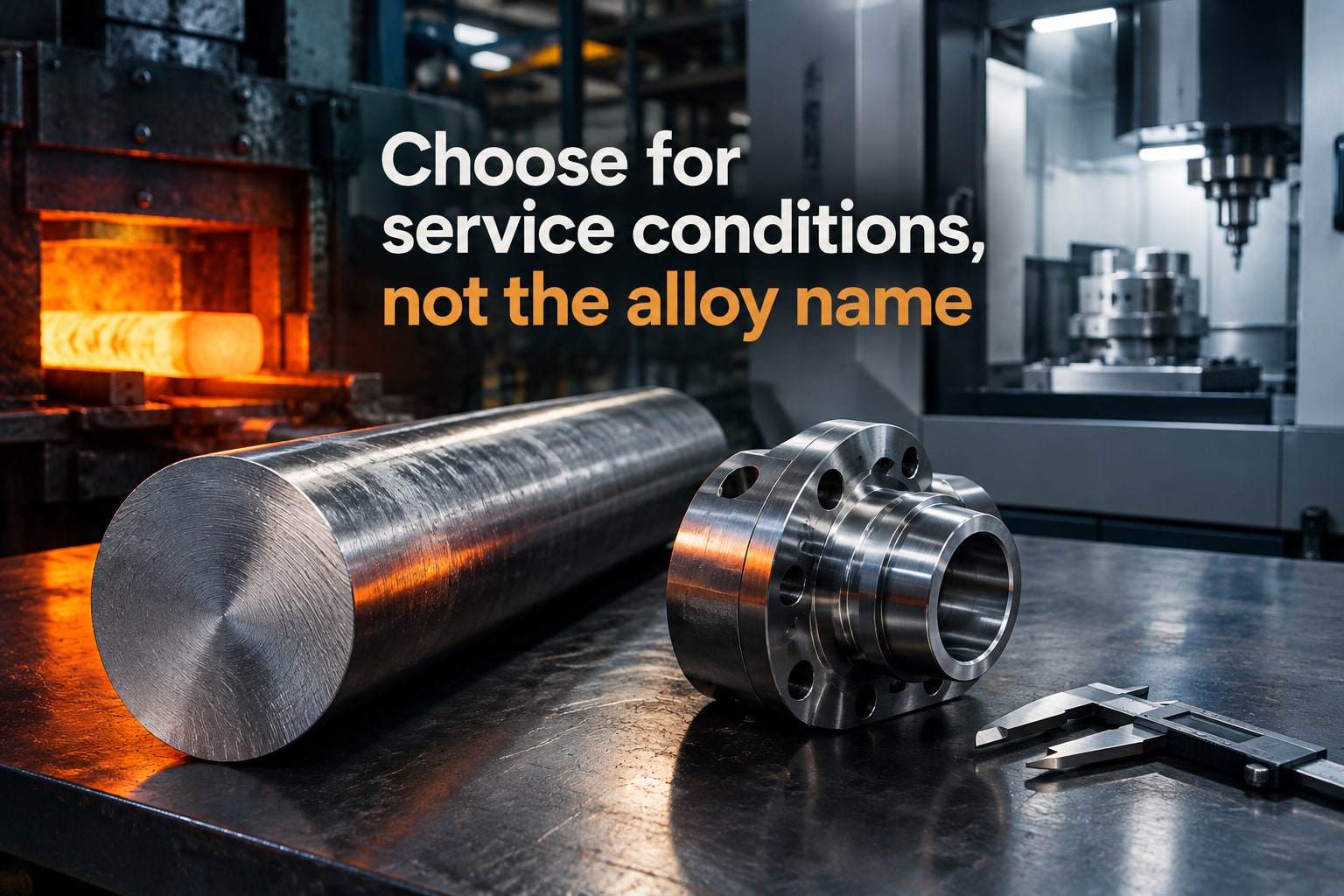
Choosing a super duplex grade starts with chloride exposure, temperature, geometry and fabrication controls—not with a catalogue label or a nominal size. By the end, you will be able to screen the alloy, compare grades and alternatives, write a traceable purchase specification, and assess whether a supplier can deliver material fit for service.
Key takeaways
- Start with chloride level, temperature and crevice geometry.
- Match grade selection to corrosion duty, strength and design trade-offs.
- Confirm welding and heat treatment will preserve the phase balance.
- Specify sizes, tolerances, condition, testing and certification before ordering.
Start with the service environment, not the alloy name
Chloride concentration, temperature and crevice geometry decide whether super duplex special metal is suitable; the alloy name comes later. “Super duplex” is a commercial description, not one standardized grade. These alloys target an approximately 50:50 ferrite-austenite balance: chromium forms a protective passive film, molybdenum improves pitting resistance, and nitrogen raises pitting resistance and strength.
Screen with PREN = %Cr + 3.3(%Mo) + 16(%N). A PREN around 40 or higher is a convention, not a service-life guarantee.
- Record chloride concentration and whether exposure involves seawater, brine, deposits or oxygenated water.
- Define pH, temperature, pressure, erosion rate, stagnant zones and tight crevices around gaskets, supports and flange faces.
- Set the required design life, then compare localized-corrosion risk with inspection access and cleaning capability.
- Treat PREN as a ranking tool only. It does not predict crevice corrosion, weld-zone performance or service life; contaminated surfaces, poor weld cleaning and tight crevices can attack super duplex.
316L offers easier welding, machining and availability, but lower chloride resistance. Standard duplex 2205 provides high strength at moderate cost. Super duplex raises corrosion resistance and strength but increases fabrication effort. Nickel alloys buy wider corrosion margins at higher material cost, while 17-4 PH prioritizes strength and machinability over chloride resistance.
| Option | Main position |
|---|---|
| 316L | Easiest fabrication; lowest chloride resistance |
| 2205 | Balanced strength, corrosion resistance and availability |
| Super duplex | Higher chloride resistance; demanding fabrication |
| Nickel alloys | Broad corrosion margin; highest material cost |
| 17-4 PH | High strength and machinability; poor chloride choice |
Match the grade to the duty and the design trade-offs
UNS S32750, commonly called 2507, contains approximately 24–26% chromium, 3–5% molybdenum, 6–8% nickel and 0.24–0.32% nitrogen. Do not treat “2507-type” as an interchangeable designation.
| Grade | Selection point | Purchase implication |
|---|---|---|
| UNS S32750 (2507) | Defined Cr-Ni-Mo-N super duplex chemistry | Name UNS S32750 and the governing product standard |
| UNS S32760 | Similar base chemistry, with permitted tungsten and copper additions | Do not substitute it for S32750; specify UNS S32760 exactly |
Both grades suit seawater piping, desalination equipment, offshore oil and gas systems, chemical-process vessels, heat exchangers, pumps, valves, flanges, scrubbers and pressure-containing parts. Each application still needs a service review covering chloride concentration, temperature, oxygen, pH, erosion, crevice geometry, pressure and design code.
High strength can permit thinner sections, but it does not guarantee lower project cost. Cutting and machining demand greater force, while welding, inspection and procedure qualification require tighter control of heat input and ferrite-austenite balance.
Choose another material when the job is:
- Low-cost general fabrication or easy cold forming.
- Exposed to high-temperature hydrogen-damage risk.
- Held for prolonged periods around 300–500 °C, where embrittlement risk rises.
- Designed without reliable control of welding heat input, interpass temperature and phase balance.
A purchase order must state the exact UNS grade, product form and governing standard. A material labelled only “super duplex” leaves the supplier and fabricator room to deliver the wrong chemistry or qualification basis.
Check whether your fabrication route can preserve performance
Solution annealing followed by rapid cooling is essential: producer guidance commonly places the treatment around 1,020–1,100 °C, followed by water quenching. The specified UNS grade and product standard control the exact temperature, hold time and cooling requirement.
Slow cooling, repeated forging heats or exposure around 600–1,000 °C can form sigma, chi and other intermetallic phases. These phases reduce impact toughness and localized-corrosion resistance, even when the finished surface looks acceptable.
Check that your fabrication route includes:
- Hot forming within the qualified temperature range, with reheating controlled to prevent repeated intermetallic-forming exposures.
- Cold forming only after assessing the high forming force and springback; difficult bends can distort dimensions or initiate cracking.
- Machining parameters that account for high cutting forces and rapid tooling wear. Use rigid setups, sharp tooling and an agreed allowance for finishing.
- Pickling and passivation after fabrication, with complete removal of heat-tinted oxide. Leaving oxide behind can destroy the intended corrosion resistance.
- Welding with an approved filler metal, controlled heat input, interpass-temperature limits, clean shielding gas and a root purge. Protect the weld from nitrogen loss and oxidation.
Accept welds using ferrite-austenite balance, corrosion performance and relevant nondestructive examination, not visual appearance alone. Specify ASTM A923 corrosion, Charpy-impact or metallographic testing for detrimental intermetallic phases; the purchase or welding specification must name the method and acceptance criteria.
Turn “super duplex sizes” into a complete material specification
Asking only for super duplex special metal sizes is inadequate because a dimension does not identify the grade, product form, manufacturing route, heat treatment or traceability. Convert the request into a controlled material specification.
1. Name the product form: plate, sheet, round bar, hollow bar, pipe, tube, fitting, flange or forging. State outside diameter, wall thickness, length, nominal size, schedule or dimensional standard, tolerances, supplied condition and machining allowance.
2. Cite the form-specific standard: ASTM A240 for plate, sheet and strip; ASTM A790 for seamless and welded pipe; ASTM A928 for welded duplex pipe made with filler metal; ASTM A276 for bar and shapes; ASTM A479 for pressure-vessel and general-purpose bar and shapes; or ASTM A182 for forged flanges, fittings, valves and pressure parts.
3. State the exact UNS grade, such as UNS S32750 or UNS S32760, plus the solution-annealing condition and heat number. Do not accept “2507-type” as a complete designation.
4. Require an EN 10204 3.1 material test certificate tied to that heat number, including chemical analysis, tensile results, impact results where specified, and ferrite verification.
5. Add corrosion or ASTM A923 records where required, together with ultrasonic testing, hardness testing or positive material identification requirements. Confirm the standard edition and purchaser’s design code before ordering; otherwise a correctly sized item can still fail acceptance or require costly rework.
Separate supplier checks from engineering approval
Approve the alloy and the vendor as separate decisions. A super duplex supplier in Mumbai is not validated by location, and a catalogue label is not an engineering approval.
| Material selection | Supplier selection |
|---|---|
| Chloride and temperature limits; pressure; design life; crevice and erosion conditions | Stock or mill-order lead time; minimum order quantity; certified offcuts |
| Exact UNS grade, product form and dimensions, including tolerances | Ability to source the exact grade and form; local cutting or machining capability |
| Solution-annealing condition and heat treatment records | Heat-specific delivery documentation and EN 10204 3.1 certification |
| Weld procedure qualification, filler metal, heat input and interpass limits | Heat-number traceability from product markings to certificate |
| Required chemistry, tensile, impact, ferrite, corrosion or ASTM A923 tests, plus UT, hardness, PMI or NDE where specified | Evidence that chemistry and mechanical values match the supplied heat |
For “super duplex metal in Mumbai”, match the heat number on the product, markings and certificate. Verify dimensions and transport damage, then inspect for iron particles, carbon-steel contact, chloride contamination and poor storage.
Involve a materials engineer when pressure, temperature, design life or code compliance is uncertain. Use a corrosion specialist for chloride, crevice, erosion or deposits; involve a welding engineer before fabrication or procedure approval. Steel Mart can be evaluated against these same traceability, documentation, machining and exact-grade criteria rather than chosen on location alone.
Related product
 | Non Ferrous Metals Super Duplex Stainless Steel is a high-performance special metal that combines the benefits of austenitic and ferritic stainless steels. View product → |
Frequently asked questions
What service conditions determine whether super duplex metal is suitable?
Assess chloride concentration, operating temperature and crevice geometry before choosing an alloy. These conditions control pitting, crevice corrosion and stress-corrosion risk.
How do you match a super duplex grade to an application?
Compare the required corrosion resistance, strength, toughness, weldability and design limits against the specific grade’s chemistry and mechanical properties.
How can fabrication affect super duplex performance?
Control welding heat input, interpass temperature, shielding gas, cooling and post-weld inspection so the ferrite-austenite balance and corrosion resistance remain within specification.
What should a complete super duplex material specification include?
State the grade, product form, dimensions, tolerances, delivery condition, applicable standard, tests, heat number, inspection documents and certification requirements.